Peer Review : 4

Hey Grace,

I chose to go back to the start for my last peer review, and I’m really glad I did.

I don’t have any ethnic background other than Australian, but over the past year I’ve been with my partner who is Lebanese. It was gratifying reading your experience with your definition of “An Australian” compared to your experiences as a Lebanese women.

I really liked your last line

“Without each community, Australia would be a little less multicultural and diverse”

This resonated with me looking back onto the unit and how we have learned so much about the Australian Identity and how that transcends into literature.

I also really liked the two flags as your image.

Thank you!

Summative Entry

Australia is not a finished product

At the start of this unit, I admittedly didn’t know a lot about Australian literature compared to some of my peers. While I love to read, I haven’t read the ‘classics’, let alone Early Colonial Poetry.

It was with delight that we started with writing by and about Indigenous Australians. Such a wealth of knowledge and deep emotion.

Nothing called to me more in the unit than in this section. This was amplified in the gallery visit we undertook with the beautiful artistry displayed.

My favourite piece from that section was Judith Wright’s “Niggers Leap”. The irony and her opaque writing style highlighted her message for me, making it one of my favourite pieces for the semester.

 “Did we not know their blood channelled our rivers,
and the black dust our crops ate was their dust?
O all men are one man at last.”

Succeeding, the unit formed into Early European / Australian authors. I found it interesting reading literature that was in a way degrading the Australian landscape in its description depicting a barrow and non-providing land. The European mindset came out vividly in this period, which provided an excellent contrast to the subsequent literature we studied.

Fast Forwarding to New Australian Poetry – Oh, how times have changed!

I feel a lot more well versed into how far come Australia has come in its literary identity. However,

Australia is not a finished product

We are a relatively young continent by any means and have a lot of room ahead of us to be ever-changing and use our diverse population to our advantage. Australian Literature shouldn’t pre-maturely stunt its growth into adapting to our supposed Australian Identity. We have such a diverse, cultural populace, that without sounding too cliché’, the sky really is the limit.

PEER REVIEW: 3

Charles Lilienthal – Week 5 – Art Gallery Visit

Hey Charles,

I enjoyed your response to our art gallery visit and what works that you found challenging/interesting.

I particularly liked how you started in outlining the works that were depicted, namely – The Gold Rush, Colonial Frontiers of Australia and Early Indigenous Artworks.

Additionally, I found your favourite works (specifically the Ned Kelly artwork) an interesting choice. Your explanation accompanying it also helped my understanding.

From a readability point of view, the only criticism I could make is utilising structure to your advantage. Your points would have been even more impactful if they were structured with paragraphs as well as it would make it easier on the readers eyes.

Looking forward to reading more of your work,

Serena Doran

https://unsplash.com/photos/VYw9TQyHXns

BLOG POST 4 – CREATIVE

September 16, 2019

Dear Mr. White:

I am writing this letter in regard to your literary work “Miss Slattery and her Demon Lover”. I regret to inform you, that this is not a letter of complimentary nature. Whilst I would like to give only praises, unfortunately this piece did not sit right with me.

I found this story a grotesque image of partying in Australia and whilst you might have been focusing on soulless fun – as you have with other stories of yours, I found this story lacking substance. I found the Hungarian aspect of language hard to follow and was underwhelmed by your portrayal of women in this piece. Miss Flattery was displayed as needing Tibby to the detriment of herself and her work, then she leaves him at the end. As a reader, I wonder, was your intention to criticize Miss Flattery or Tibby?

In good nature, I did find the writing style flowed well, and did invoke a sense of foreboding and storytelling. I am not completely impolite.

As I am not a top-notch critic, or an avid writer, you can ultimately take my criticism with a grain of salt.

Thank you for your time

Sincerely,

Serena Doran

https://unsplash.com/photos/FluPNkHfCTs

Blog Post 3 – Critical

Critical “Write a brief account of how you think art and literature interact in a person’s experience?”

Art and literature have always been intertwined throughout time, almost like the ebb and flow of the arts. Both have evolved through time as a result, such as romanticism and modernism, as well as major events such as World Wars. In my opinion, I believe art and literature interact to become the foundation of the human experience; the desire to connect to others and create relationships.

The expression of the content of these pieces, are at the core of an individual’s experience in how they interact with the world. People draw meaning and relate to the range of emotion and characteristics that amass when creating art and literature. People see purpose and meaning in their life because of these pieces, the courage to create poignant works of self-expression.

For me personally, I have loved to read ever since I was a little girl and my grandfather first let me into his collection – which was not filtered out, I might add. Growing up reading Stephen King and Dan Brown, broadened my mindset into what I see as valuable, in addition, the meaning I get from life. A lot of people I meet ask me why I read, and to the extent I do. Getting lost in a book and being late for something is commonplace for me.

The answer?

I believe novels can educate, that they can translate human emotion and experience into a simple sentence. Some stories are powerful enough to stay with you and alter your mindset no matter what genre they come from. While I have not been exposed to art as much, or had a desire to do so, I believe both create meaning for an individual’s experience that transcends society and culture expectations.

https://unsplash.com/photos/E3AQ09IW6oA

Peer Review: 2

Jesse Owad’s Blog – Blog 2 – Critical

CRITICAL – What does A.D. Hope’s poem Australia (written half a century after the 1890s) add to the debate on what is Australia?

Hey Jesse,

This was a very beautifully written piece that conveyed your points in a clear, direct manner. I felt that you felt very strongly about your post which amplified the effect of the text and enhanced my understanding.

I particularly enjoyed the ending in throwing it back onto your audience to form their opinion after a well laid out argument and analysis. There was also effective evidence, in which you pointed out examples in the stanzas, and explained the meaning behind literary techniques.

The only criticism I could point out is from a readability point of view, implementing paragraphs or spaces between your points would improve the flow and help the reader.

Look forward to hearing more of your work,

Thankyou 😊

https://unsplash.com/photos/5DD-zrySSXc

Peer Review : 1

Dylan Versola’s Blog 1 – Critical

Which poem or story that we have looked at so far made an impression on you? What was the impression it made? Why did it touch your feelings and imagination?

Hi Dylan,

I enjoyed your piece of writing on “A mid-summer noon in the Australian Forrest”, highlighting how it made an impression on you. You used strong examples of personification, imagery and pointing out purposeful adjectives in the text. This showed that not only did you draw techniques from the text, but understood the themes intertwined with these literary devices.  I particularly enjoyed how you related it to your childhood and how that comes full circle for you.

My recommendation for you would be to focus on your paragraph and sentence structure. Your writing would be even more impactful if you read it aloud to yourself, to see where sentences may be too long, or a new paragraph should be started to present a new idea.

An example of your opening sentence could be:

Before

 The continuous use of personification used throughout Charles Harpur’s ‘A mid-summer noon in the Australian Forrest’ invigorated my imagination through its slumberous pacing, it presents imagery to my head of a living sun falling asleep as the it lays, so will the sunlight be nearing nightfall.

After

Charles Harpur’s, ‘A mid-summer noon in the Australian Forrest’, made an impression on me due to its clever techniques such as; personification, imagery and purposeful use of adjectives. Harpur’s slumberous pacing invigorated my imagination, presenting imagery of a living sun falling asleep as it lays.

This is just my opinion as a peer reading your piece in terms of flow, structure and readability. I look forward to reading more of your work.

Thankyou!

https://images.unsplash.com/photo-1535182481664-c9c02090dc4f?ixlib=rb-1.2.1&ixid=eyJhcHBfaWQiOjEyMDd9&auto=format&fit=crop&w=600&q=60

Blog Post 2 – Creative

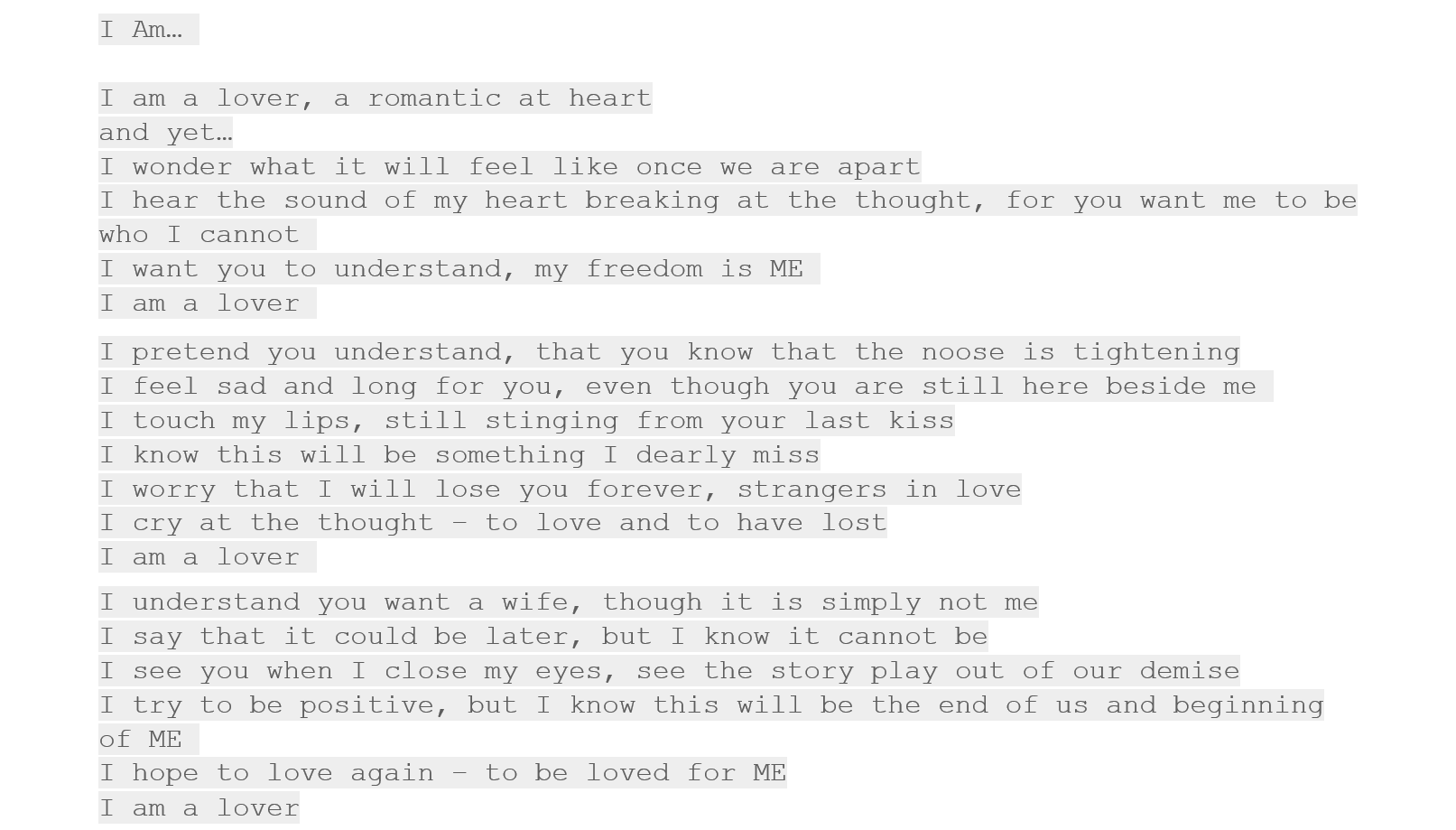
 “And then we must be free to kiss and part”. Write a short letter or poem that proclaims the kind of personal freedom that Ada Cambridge proposes in this line.

Due to layout issues I had to post the poem I wrote as an image. It’s meant to convey the freedom Ada Cambridge is experiencing; in going against the grain and social conventions of being a wife to ultimately being free as both a lover and her individual identity.

https://unsplash.com/photos/cOW3_hqmWp4

Blog Post 1 – Critical

“Discuss what you think are the key differences and benefits of poetry that is ‘transparent’ versus poetry that is ‘opaque’.”

My own definition of poetry is that it is an artistic creation that encapsulates the vulnerabilities, perplexities and triumphs of both human nature and the greater world. Through time, there have been assorted styles of poetry, two of which I will be addressing. In this blog post, I will compare the benefits of both opaque and transparent poetry, while also pointing out some key differences using Australian literature to highlight and contrast.

“Did we not know their blood channelled our rivers, and the black dust our crops ate was their dust? O all men are one man at last.”

– Judith Wright “Niggers Leap”

Opaque poetry refers to poetry that is difficult to derive obvious meaning from. That is, you read and are often perplexed as to what the author is saying and the concept they are trying to convey. This could be for a multitude of reasons: the language in that time, context, literary devices and of course the readers own literary background and expertise.

A benefit of opaque poetry is its ability to articulate human nature in such a way that resonates long after you finish reading the poem. Poetry that is written in this manner often employs complex figurative language and techniques such as juxtapose, paradox and explementary use of syntax. This method of poetry not only gives a lasting impact but shows how well thought out these poems can be. This therefore enables their literature to have numerous twists and turns, presenting variable but deep meaning to the individual reader.

This is evident in the poem “Niggers Leap” by Judith Wright. She authors a compelling piece of the brutality indigenous people suffered and, in this instance, the expulsion of Aboriginal people off a cliff-face. Wright feels for her country immensely in this piece which is presented in the powerful, ironic line, “Did we not know their blood channeled our rivers, and the black dust our crops ate was their dust? O all men are one man at last.”

Contrastingly, Transparent poetry bears its meaning and purpose in a clear and direct manner. This method of poetry almost leaps off the page at you, where the poet wants to make an impact to enhance the readers understanding of the text. This can be more enjoyable for the reader, as they can take pleasure in knowing the authors true intentions and identifying with those meanings and concepts in a present-day setting.

Consequently, a benefit of Transparent poetry is that it presents an immediate reaction and feeling with the reader. Traits of this poetry often include: obvious imagery, sound patterning, simple word choice and sentence structure. This is not to state that it is a simple form of poetry by any means, it takes an artistic mind to create these pieces.

An example of this immediate reaction is in the poem “Urbanised Reeboks” by Lisa Bellear. In this piece, the reader quickly notices the deliberate misspelling of “Blak”. The author emphasises the harshness of ‘K’ in nearly cacophony to illustrate a separation from the European way of speaking and sounding.

In concluding, I would summarise that both forms of poetry have key benefits and differences and it is the prerogative of the reader in which they choose to enjoy stimulating their mind with.